

Service Program
Emergent Water Security
Remediate active threats to water security with our heavy duty oxidation programs
Temporary service, run as a project
When it fits
When An Emergent Project Fits
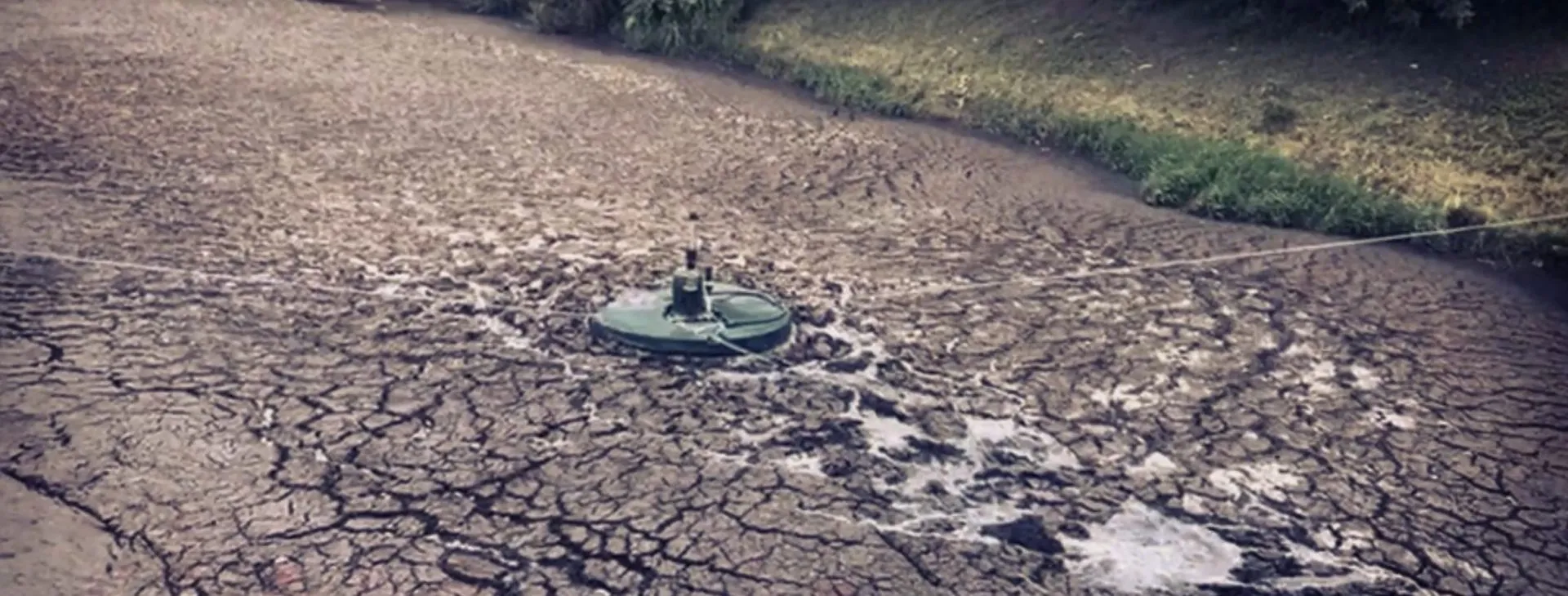
Emergent remediates active threats to water security with heavy duty oxidation programs. It applies when the water is already out of tolerance and the trigger is visible and dated: a bloom that has taken a lagoon, a hypoxic layer forming through the water column, sediment and sludge that has stopped responding to the existing treatment train, or a contaminant load the site was never designed to carry.
In-situ deployment is what makes a project response practical. A Guardian stands roughly 37 inches high by 12 inches wide by 8 inches long, weighs about 82 pounds and floats, so oxidation capacity goes directly onto the affected water instead of requiring a diversion to a plant. Portable in-situ equipment also needs less permitting, less supporting equipment and less space than a fixed installation.
A California golf course's water healed in 80 days with 1 Axbold Nanobubbler on 1 of 5 ponds. On any other site the characterization sets what the project treats and what it is measured against.
- Algae blooms, dead zones and hypoxic layers requiring intervention
- Sediment and sludge that has stopped responding to existing treatment
- Contamination events involving heavy metals, bacteria, viruses or surfactants
- Outfalls, canals, rivers and lakes needing a defined correction
- Finite problems that cannot justify a permanent capital installation
What you get
Heavy Duty Oxidation In Situ
Emergent runs the Guardian at heavy duty settings. Gas throughput is 171.9 LPM (45.4 GPM) at 90% mass transfer into the fluid. By mass, the platform delivers up to 368 grams per minute of ozone or 245 grams per minute of oxygen, both subject to generation capability, or 222 grams per minute of air. Aeration capacity at 45.4 gas GPM is 72% greater than conventional nanobubble units deliver.
Ozone nanobubbles shred toxins by eviscerating them at the functional group level. That mechanism is what the platform brings to bear on heavy metals such as selenium and arsenic, on harmful bacteria and viruses, and on toxins like plastic leachate. Treatment runs without chemicals and without invasive intervention, and the nanobubbles themselves, 220 million per mL, are electrically charged, highly pressurized and can stay in solution for months.
Unit count and duty follow the measured volume and turnover of the water body, and the gas follows the contaminant data. Testing runs before, during and after the project window, so the water at close is read against the baseline taken before mobilization.
- Site assessment and water characterization before mobilization
- Solution consulting, treatment design and gas selection
- Guardian platforms, transport, in-situ deployment and demobilization
- Heavy duty operation, up to 368 grams per minute of ozone subject to generation capability
- Testing through the project window with before and after data
- Close-out reporting and an assessment of ongoing risk
How it is structured
Project, Not Program
Emergent is a temporary service, structured and run as a project. It has a defined start, a defined treatment intensity and defined completion criteria agreed before mobilization. Axbold brings the platforms in, operates them for the project window, and takes them out again at close.
The equipment stays on the Axbold side throughout. Nothing is capitalized by the client and there is no residual maintenance obligation once the project ends. Where the underlying risk is seasonal or structural rather than one-off, the close-out report says so, and many sites move from an Emergent project into a Proactive program on the same water.
- Temporary service, scoped and run as a project
- Defined start, treatment intensity and completion criteria
- Axbold mobilizes, operates and demobilizes the platforms
- Equipment returns to Axbold at project close, nothing capitalized
- Common path into a Proactive program once the water is back in tolerance
- Consulting, testing and data services included, or available separately
Common questions
What sets the intensity an Emergent project runs at?
The characterization. Testing before mobilization establishes contaminant load, dissolved oxygen profile, volume, turnover and the physical shape of the site, and those results set the gas, the unit count and the duty the platforms run at. Ozone duty is available up to 368 grams per minute, subject to generation capability, and is selected where the load calls for oxidation rather than aeration.
Does the treatment involve chemical dosing?
No. The platforms swiftly balance seas, outfalls, lakes, ponds, lagoons, rivers and more without chemicals or invasive interventions. The active agent is gas infused as nanobubbles, with ozone, oxygen or air selected against the characterization results.
What happens to the equipment when the project ends?
It demobilizes with the Axbold crew. Emergent carries no capital transfer and no residual maintenance obligation. If the close-out data indicates the risk is recurring rather than resolved, the options are a Proactive program, where Axbold retains the assets, or Embedded, where the client owns them.
Can Emergent work on a site that already has a treatment plant?
Yes. In-situ deployment puts oxidation directly on the affected water, which makes it usable as pre-treatment or as an intervention upstream of existing infrastructure. Desalus is a water and food security company that makes clean water and pure fertilizer from its zero-waste water treatment services. To address serious water and food security in challenging areas, Desalus relies on Axbold for important pre-treatment capabilities.
Connect
Start an emergent program
Tell us the water body, the target and the constraint. We will tell you whether this is the right shape of program for it.