

Systems

Systems

Our equipment infuses ultra fine bubbles of oxygen, ozone and/or other gas into seawater, freshwater, and/or other liquid with superior efficiency and minimal maintenance.

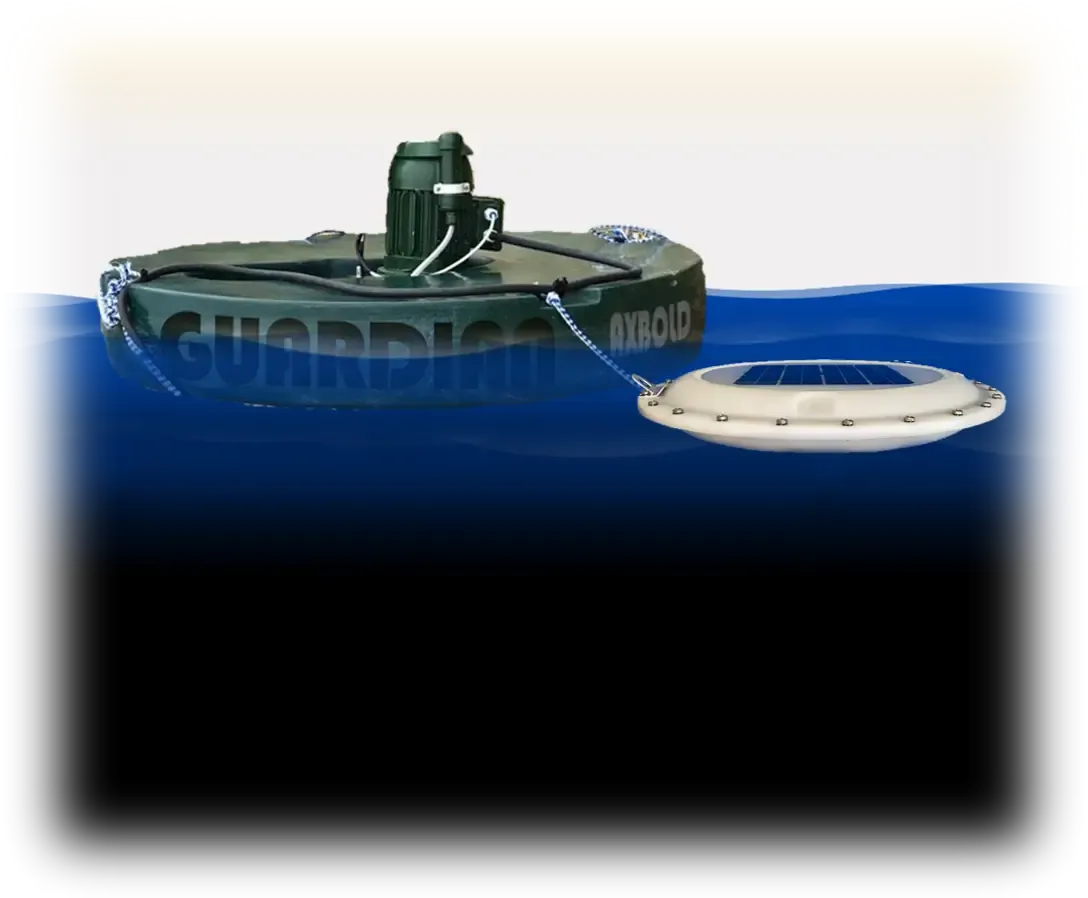
Axbold equipment infuses ultra fine bubbles of oxygen, ozone and/or other gas into seawater, freshwater and/or other liquid with superior efficiency and minimal maintenance. Floating platform configurations enable aeration, oxidation and other gas-into-liquid facilities in situ, addressing risks more directly. One platform carries that duty across every water type. It is the Axbold Guardian, which carries the throughput, bubble population, power and construction figures in full.

The design premise is that treatment should sit inside the water body, not beside it. Placing the gas transfer stage directly in a lagoon, pond, outfall, tank or process circuit removes the pumping, piping and civil work a shoreside plant requires, and it removes the lag between where a problem develops and where the equipment can act on it. Four engineering decisions follow from holding that constraint.

Our floating platform configurations enable aeration, oxidation, and other gas-into-liquid facilities in situ, addressing risks more directly.

Ask us about the Guardian

An Axbold nanobubble generation system deployed on open water

Engineering principles

What the equipment is optimised for

Treatment Inside The Water Body

The platform floats. Treatment goes to the water rather than the water being brought to treatment, which is why there is no basin to excavate, no transfer pumping to size and no shoreside building to fit out. Holding the gas transfer stage inside the water body is what removes the permitting, equipment and space a fixed installation needs. Where there is no free surface to float on, submersible, air-cooled and in-line configurations do the same job inside a tank or a pipe run.

Power A Site Can Actually Supply

A unit floating on a remote pond has to run on whatever power that shoreline can give it, so low consumption is a siting decision before it is an operating cost. Because nothing has to be lifted ashore, treated and returned, the energy budget goes to gas transfer rather than to conveyance. The result is a machine that runs off ordinary site power, and off solar panels where there is none.

Durability With Few Moving Parts

Equipment left floating on a water body cannot be attended the way a plant is. The design response is to remove failure modes rather than to make them serviceable, which is how the platform ends up with two moving parts and an enclosure specified for continuous immersion in seawater as well as freshwater rather than for shelter inside a building. Fewer rotating and wearing components means the service interval is set in advance instead of being written by whatever breaks first.

Dissolution, Not Agitation

Coarse aeration puts gas into water and lets most of it rise and vent to atmosphere, so much of the gas a site pays to produce is spent on the sky above it. Axbold equipment is built to dissolve gas instead. Bubbles small enough that buoyancy no longer governs them disperse through the water column rather than rising out of it, and because they are electrically charged and highly pressurized they can stay in solution for months. Concentration, average bubble size and the share of gas that transfers into the fluid are measured figures, published in full on the Guardian.

Axbold Guardian

The numbers that define the platform

220M

Nanobubbles Per mL

Roughly one billion per teaspoon

76 nm

Average Bubble Size

NanoSight nanoparticle tracking analysis

2.7 kWh

Energy Consumption

79% less than conventional nanobubble units

90%

Gas Mass Transfer

Into the fluid, not out to atmosphere

Common questions

Which Configuration Suits Which Water Body?

The standard configuration floats on the water body and includes a submersible enclosure, while air-cooled and in-line options are available where the application calls for them. Floating configurations suit ponds, lagoons, outfalls, lakes and rivers; submersible placement suits deeper or more exposed water; in-line arrangements suit process circuits and pipe work where there is no free surface to float on.

What Changes Between One Water Type And The Next?

The gas selected and how long it runs. The platform itself does not change: air, oxygen and ozone move through the same equipment. Ozone shreds toxins at the functional group level, oxygen nanobubbles improve oxygen transfer efficiency by 80,000 times, and natural air nanobubbles activate aerobic growth for healthier water. The solution pages set out each duty in its own operating context.

How Do Systems And Services Fit Together?

The equipment is delivered through a water security service program rather than as a standalone purchase. Proactive programs mitigate risks to water security, Emergent programs remediate active threats with heavy duty oxidation, and Embedded programs apply where the physical assets need to sit on the balance sheet. Every water security program has built-in solution consulting, testing and data services, and those services can also be procured independently.

Connect

Ask us about the Guardian

Tell us the water body, the gas you need in it and the constraint you are working against. We will tell you what the platform would do about it.