

Dissolved Oxygen
Aquaculture & Agriculture
Boost profits from better yields with less energy (more biomass given increased feed conversion from optimized dissolved oxygen levels throughout water column).
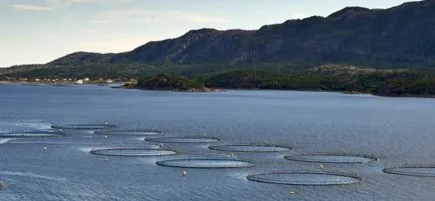
- Finfish farms
- Shrimp ponds and raceways
- Hatcheries and nurseries
- Irrigation districts
- Row crop and orchard growers
- Aquaponics operators
The problem
Oxygen That Will Not Stay
Conventional aeration puts gas into the water at one point and then loses most of it. Coarse bubbles rise, coalesce and vent at the surface within seconds, so dissolved oxygen is highest near the diffuser or paddlewheel and lowest through the rest of the column. Operators compensate by running more aeration hours as density climbs, which raises the energy bill without correcting the gradient.
The cost surfaces in feed before it surfaces anywhere else. When dissolved oxygen sits below the range a species metabolizes efficiently, feed conversion degrades and a share of every load purchased stops becoming harvestable biomass. Hypoxia is the end state of that curve, and without oxygen aquatic life dies. A pond that has already gone past that point into standing algae and sludge is a remediation case rather than an aeration one.
- Stratified column with oxygen concentrated near the aerator
- Coarse bubbles coalesce and vent before gas transfer completes
- Aeration energy scales with stocking density, not with delivered oxygen
- Feed conversion degrades quietly before mortality makes it visible
- Irrigation reservoirs and storage ponds face the same gradient over larger surface areas
How it works
Nanobubbles Hold Dissolved Oxygen
The Axbold Guardian shears gas into nanobubbles averaging 76 nm, independently measured by NanoSight nanoparticle tracking analysis, at a concentration of 220 million nanobubbles per mL, roughly 1 billion per teaspoon. At that scale buoyancy stops governing behavior. A bubble that small carries too little lift to rise out of the column, so it moves with the water rather than through it.
Axbold nanobubbles can stay in solution for months, are electrically charged and are highly pressurized. The surface charge keeps them mutually repelled, so they do not merge into the coarse bubbles that vent at the surface. The practical consequence is that the dissolved oxygen stays where the stock is, at depth, between feeds and overnight.
Gas throughput is 171.9 LPM (45.4 GPM) at 90% mass transfer into the fluid. By mass, the platform delivers up to 245 grams per minute of oxygen, subject to generation capability, or 222 grams per minute of air. Air nanobubbles activate aerobic growth for healthier water, and oxygen nanobubbles improve oxygen transfer efficiency by 80,000 times.
- Average bubble size 76 nm, NanoSight proven, at 220 million per mL
- 90% mass transfer into the fluid at 171.9 LPM (45.4 GPM) of gas
- Charged surfaces resist coalescence, so bubbles stay dispersed
- Months of persistence in solution instead of seconds of rise time
- Up to 245 g/min oxygen subject to generation capability, or 222 g/min air
- Floating in-situ deployment, with in-line and air-cooled options
220M
Nanobubbles Per mL
Roughly 1 billion per teaspoon
245 g/min
Oxygen Infusion
Subject to generation capability
90%
Mass Transfer
Gas into fluid at 45.4 GPM
2.7 kWh
Energy Consumption
79% less than conventional nanobubble units
What changes
More Biomass Per kWh
Holding dissolved oxygen through the whole column rather than near one device is what makes better feed conversion available, and better feed conversion turns the same purchased load into more harvestable biomass on less energy than conventional nanobubble units require. The delivery is the constant: 220 million nanobubbles per mL at an average of 76 nm, 90% mass transfer into the fluid, and up to 245 grams per minute of oxygen subject to generation capability. Dissolved oxygen through the column is then measured against a baseline taken from your own water, since every Axbold program carries built-in solution consulting, testing and data services.
Placement matters as much as throughput on a working farm. At roughly 37 inches high and 82 pounds, an Axbold Guardian is set and relocated without a crane or a permanent pad, so supporting one more pond this cycle is a placement decision rather than a construction project, and the platform can follow the stock as grow-out moves between raceways.
- Dissolved oxygen distributed through the column, not banked at the aerator
- Operates on 2.7 kWh and moves 3,437 gas liters per kWh (908 gas gallons per kWh)
- 79% less energy and 90% less servicing time than conventional nanobubble units
- Two moving parts and a quarterly checkup of one hour or less
- Solar-capable for remote ponds, raceways and irrigation reservoirs
- 10 year useful life on IP68 Grade 316 stainless construction
Common questions
Does this replace our existing aeration?
A single Guardian moves 171.9 LPM (45.4 GPM) of gas at 90% mass transfer into the fluid, and aeration capacity at 45.4 gas GPM is 72% greater than conventional nanobubble units deliver. Axbold evaluates one pond or raceway first and sizes from measured results, setting the platform alongside existing equipment or in place of it according to what that water shows.
How long do the nanobubbles last in the water?
Axbold nanobubbles can stay in solution for months. At an average diameter of 76 nm they carry too little buoyancy to rise and vent the way coarse bubbles do, and their electrical charge keeps them from coalescing into larger bubbles. That persistence is the reason dissolved oxygen stays distributed through the column instead of concentrating near the aerator.
What does it cost to operate?
Energy and a quarterly checkup are the running costs, and neither of them climbs with stocking density the way aeration hours do. Conventional aeration answers a heavier load by running longer, so the operating line tracks the stocking curve upward. A Guardian holds dissolved oxygen through the column on a fixed energy consumption, so that line stays flat while biomass rises.
Will it work in seawater as well as freshwater?
Yes. The equipment infuses ultra fine bubbles of oxygen, ozone or other gas into seawater, freshwater or other liquid. Nothing goes into the water but gas, so there is no reagent chemistry to re-formulate for a marine site, and the enclosure is built for immersion in either. Gas selection and duty cycle are set per site.
Can the system run with stock in the water?
Yes. Air and oxygen duty are the standard configurations for holding dissolved oxygen through a stocked column, and ozone is used in recirculating aquaculture systems as well, carefully monitored and controlled. Axbold's proprietary systems keep ozone from off-gassing above safe limits. Which gas runs on your water, and at what duty cycle, is set during characterization rather than assumed.
Related
Other water, same capability
Connect
Talk about aquaculture & agriculture
Tell us the water body, the contaminant or target, the volume and what you have already tried. That is enough for a useful first answer.