

Axbold Guardian
Maximum concentration. Minimum consumption.
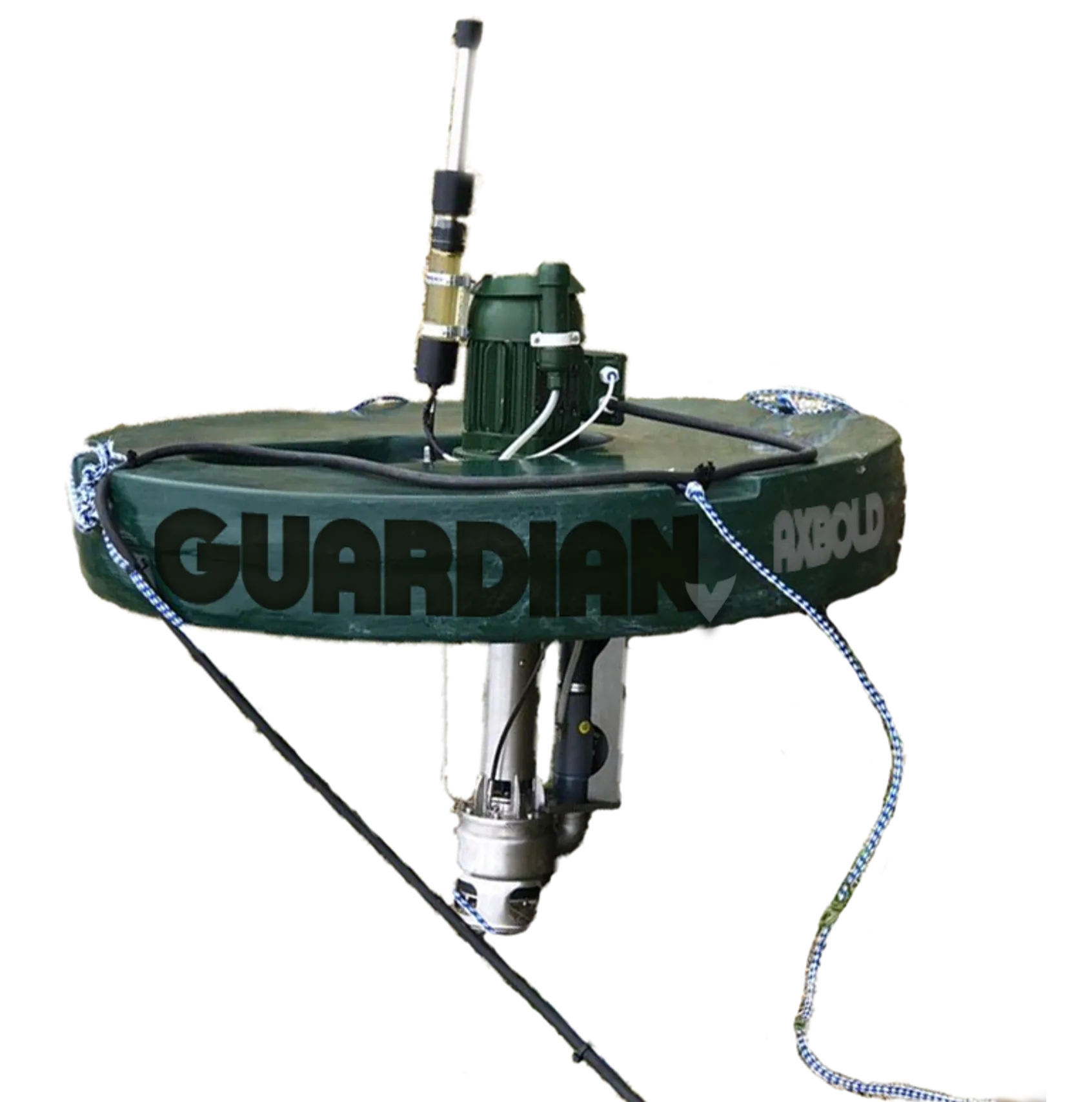
The Axbold Guardian is a floating, in-situ nanobubble oxidation platform for seawater, freshwater or other liquid. Gas throughput is 171.9 LPM (45.4 GPM) of air, oxygen or ozone at 90% mass transfer into the fluid, and the platform operates on 2.7 kWh. It produces 220 million nanobubbles per mL at an average diameter of 76 nm, from a unit that weighs roughly 82 pounds and has two moving parts.
- 220M nanobubbles / mL
- 2.7 kWh
- IP68 · Grade 316
220M
Nanobubbles Per mL
Roughly one billion per teaspoon
76 nm
Average Bubble Size
NanoSight nanoparticle tracking analysis
2.7 kWh
Energy Consumption
Platform on natural air, 79% less than conventional nanobubble units
90%
Gas Mass Transfer
Into the fluid, not out to atmosphere
How it works
Gas Dissolution At Nanoscale
Conventional diffused aeration is a race against buoyancy. A coarse or fine bubble is large enough that its rise velocity carries it to the surface in seconds, so only the fraction of gas that crosses the bubble wall on the way up ever enters solution; the remainder vents to atmosphere. The Guardian is built to lose as little of that gas as possible, delivering gas at 45.4 GPM, 90% of which transfers into the fluid.
The mechanism is size. At an average diameter of 76 nm, a bubble is small enough that buoyant force no longer governs its behavior, so it disperses through the water column instead of rising out of it. Axbold nanobubbles are electrically charged and highly pressurized, and they can stay in solution for months rather than seconds.
Concentration compounds the effect. The Guardian produces 220 million nanobubbles per mL, roughly one billion per teaspoon. That population is what carries the surface area available for gas exchange and for contact with contaminants. Oxygen nanobubbles improve oxygen transfer efficiency by 80,000 times, and ozone nanobubbles carry the same surface area and contact strength into oxidation duty, shredding toxins at the functional group level.
- 171.9 LPM (45.4 GPM) gas (air, O2, O3, etc.) at 90% mass transfer into the fluid
- 220 million nanobubbles per mL, approximately 1 billion per teaspoon
- 76 nm average bubble size, proven by NanoSight nanoparticle tracking analysis
- Nanobubbles are electrically charged, highly pressurized, and can stay in solution for months
- 222 grams/min air; 245 grams/min oxygen and 368 grams/min ozone, subject to generation capability
- 3,437 gas liters per kWh (908 gas gallons per kWh)
Specifications
Published performance
| Gas throughput | 171.9 LPM (45.4 GPM) Air, oxygen, ozone or other gas |
|---|---|
| Mass transfer into fluid | 90% |
| Air | 222 grams / min |
| Oxygen | 245 grams / min Subject to generation capability |
| Ozone | 368 grams / min Subject to generation capability |
| Nanobubble concentration | 220 million / mL Roughly one billion per teaspoon |
| Average bubble size | 76 nm Independently measured by NanoSight nanoparticle tracking analysis |
| Persistence in solution | Months Electrically charged and highly pressurized |
| Energy consumption | 2.7 kWh Platform on a natural air feed, 79% less than conventional nanobubble units. Ozone and oxygen duty also require gas generation, supplied within the service program and powered separately. |
|---|---|
| Gas efficiency | 3,437 gas liters / kWh 908 gas gallons per kWh |
| Electrical supply | Single or three phase, 120 / 240 V |
| Solar | Can be powered by solar panels |
| Enclosure | IP68, Grade 316 stainless steel |
|---|---|
| Dimensions | ≈ 37 in high × 12 in wide × 8 in long |
| Weight | ≈ 82 pounds |
| Deployment | Floats Submersible enclosure included; air-cooled and in-line options available |
| Moving parts | 2 90% less servicing time than conventional nanobubble units |
| Service interval | Quarterly checkup, 1 hour maximum |
| Useful life | 10 years |
Competitive advantage
Measured against conventional units
| Measure | Axbold Guardian | Conventional units | Difference |
|---|---|---|---|
| Aeration Capacity | 45.4 gas GPM (171.9 LPM) at 90% mass transfer into the fluid | 12.4 to 13.2 gas GPM from conventional nanobubble units | 72% greater |
| Energy Consumption | 2.7 kWh per unit, and 3,437 gas liters (908 gas gallons) per kWh | Conventional nanobubble units | 79% less |
| Maintenance Load | Two moving parts; quarterly checkup of one hour maximum across a 10 year useful life | Conventional nanobubble units | 90% less servicing time |
| Mobility | In-situ floating deployment, portable at roughly 82 pounds | Fixed installations requiring dedicated space and supporting equipment | Less permitting, equipment and space |
Deployment
Floating, In-Situ Deployment
The Guardian is built to be carried to the water rather than to have the water brought to it. At roughly 82 pounds the unit is placed and recovered without a crane, a pad or a shoreside building, and the enclosure is specified for continuous immersion in seawater as well as freshwater rather than for shelter inside a plant.
Because treatment happens in situ, there is no basin to excavate, no transfer pumping to size, no shoreside building to fit out and no piping run between the water body and the process. Portable in-situ deployment needs less permitting, less equipment and less space than a fixed installation, and a unit can be moved to a second pond, cell or outfall rather than being rebuilt there.
Configuration follows the water rather than the other way around. A floating deployment suits open ponds, lagoons, outfalls, lakes and rivers; a submersible placement suits deeper or more exposed water; air-cooled and in-line arrangements suit process circuits and pipe work where there is no free surface to float on.
- Floats; submersible enclosure included, air-cooled and in-line options also available
- Rugged IP68 Grade 316 stainless steel construction
- Compact: approximately 37 in high, 12 in wide, 8 in long
- Light: approximately 82 pounds
- Single or three phase 120/240V; operates on 2.7 kWh
- Can be powered by solar panels
Maintenance
Two Moving Parts
Fewer rotating and wearing components means fewer failure modes, and fewer failure modes is what allows a service schedule to be set in advance rather than written by whatever breaks first. Wear is concentrated in a small, known part of the machine, so the interval is short, the visit is planned, and keeping the platform running does not depend on an operator noticing a problem first.
A short, predictable service interval changes the operating relationship as much as it changes the operating cost. When a system is durable enough to be monitored proactively rather than attended reactively, the scheduled visit stops being a scramble to restore service and becomes the hour in which performance data, water chemistry and site conditions are reviewed with the people who run the site. That is the difference between a supplier who appears once something has already gone wrong and one who is in front of the water on a known cadence, with a record of how it has moved since the last visit. Axbold water security programs are built on that model, with solution consulting, testing and data services included.
- Two moving parts
- Quarterly checkup, one hour maximum
- 10 year useful life
- 90% less servicing time than conventional nanobubble units
- Grade 316 stainless steel, IP68, rated for continuous immersion
Common questions
What gases does the Guardian run?
Air, oxygen, ozone and other gases run through the same platform. Gas throughput is 171.9 LPM (45.4 GPM) at 90% mass transfer into the fluid. By mass, the platform delivers up to 368 grams per minute of ozone or 245 grams per minute of oxygen, both subject to generation capability, or 222 grams per minute of air. Air suits aerobic activity and dissolved oxygen work, oxygen suits transfer efficiency, and ozone suits oxidation of stubborn compounds.
How large a water body does one unit serve?
Coverage is established on the water itself. The testing stage measures water chemistry, contaminant loading, hydraulics and the treatment target on the specific water body, and the unit count follows from that measurement. Testing, solution consulting and data services are built into Axbold water security programs.
What power does it need?
The platform operates on 2.7 kWh and supports single or three phase supply at 120/240V, and where grid service is impractical it can be powered by solar panels. That figure is the Guardian itself on a natural air feed; ozone and oxygen duty also need gas generation, which Axbold supplies within the service program and which draws its own power. Gas efficiency is 3,437 gas liters per kWh (908 gas gallons per kWh), and platform energy consumption is 79% less than conventional nanobubble units. That figure compares the platform against other nanobubble units, not against any other class of equipment; what a platform does to a site's electricity bill is settled by measurement on that site.
How are the nanobubbles verified?
Bubble population is characterized by NanoSight nanoparticle tracking analysis, which sizes and counts particles individually rather than inferring a distribution from bulk optics. That analysis is the basis for the stated average bubble size of 76 nm and the concentration of 220 million nanobubbles per mL, roughly one billion per teaspoon.
Does it work in seawater?
Yes. The Guardian is specified for seawater, freshwater and other liquid, and the Grade 316 stainless steel IP68 enclosure is built for continuous immersion in saline conditions. Water chemistry affects the treatment result, and therefore the sizing and the gas selection, rather than the equipment's ability to operate.
What does "subject to generation capability" mean?
The 368 grams per minute of ozone and 245 grams per minute of oxygen are the platform's infusion ceilings — what the Guardian can drive into the water. Delivered mass also depends on the generation feeding it, so Axbold arranges the gas supply as part of the service program and sizes it against the duty rather than leaving it to the site. That generation is powered separately from the platform, which is why the 2.7 kWh figure is quoted for the Guardian on a natural air feed.
Is ozone duty safe around people and equipment on site?
Axbold uses proprietary systems to keep ozone from off-gassing above safe limits, and ozone duty is monitored and controlled through the life of a program rather than set and left. The same approach is what allows ozone to be used in recirculating aquaculture systems — live stock, enclosed water and continuous operation, which is the most exacting version of the question.
Connect
Ask us about the Guardian
Sizing comes out of the water, not out of a catalogue. Tell us the volume, the chemistry, the loading and the target, and we will tell you what it would take.